Gerónimo Miranda Mestre


GERÓNIMO MIRANDA MESTRE


He’s a man like me     Come from the river

Fleeing from that marvellous emotion whose

Immensity and movement are our brothers

Like him   Hammered deep into my chest

In the most sacred life experience of men

Of landscapes   Of animals flowers and trees

Of summer     Above all of summer   He is a man

who came into my life at the very best moment

I will tell him of my tired dealings with art

With madness   and with death

I will leave him in the house of my spirit as if his own

Let him rest in it      Let him if he wants lie down

in the hammock       He can look at where my words

come from         And if possible he can comfort me a little

He’s a man you can trust with the keys

Of the house and the cat which graces it

You can trust him with all the grass you have

He’s a man who is always better than you are.


Translated by Mike Baynham from a poem in Spanish by Raúl Gómez Jattín. La hamaca nuestra/Our hammock. Raúl Gómez Jattín: a queer Colombian poet in translation


Original text in Spanish


GERÓNIMO MIRANDA MESTRE


Es un hombre como yo Venido del río

Huyendo de esa emoción maravillosa de que

su inmensidad y movimiento son hermanos

nuestros Como él Hincado en lo profundo de mi pecho

Es más sagrada vivencia de hombres

De paisajes De animales flores y árboles

Del verano Sobre todo del verano Es un hombre

llegado a mi vida en su mejor momento

Le diré de mi comercio fatigado con el arte

La locura Y la muerte

Lo dejaré en la casa de mi espíritu como propia

Que descanse en ella Que se acueste si quiere

en la hamaca Que mire de dónde vienen

mis palabras Y si es posible me consuele un poco

Es un hombre en quien se pueden confiar

las llaves de la casa y el gato que la adorna

Se le puede confiar toda la yerba que tenga uno

Es un hombre que siempre es mejor que uno


Poema de Raúl Gómez Jattín

Copyright © Rubén Gómez Jattín

Brave Greece

BRAVE GREECE

Daedalus and Icarus by Charles P. Landon

Daedalus and Icarus by Charles P. Landon

Daedalus and Icarus

On the verge of the abyss

Take a leap of faith,

Against the odds of their myth,

Against the advice of the raptors,

And jump onto paradise

To save their enslaved

Mother and wife.

They proudly left behind

Their burdens and blames

And now they glide light

Through winds of disdain,

Through purgatory’s clouds

Amongst Europe’s cheers,

As they escape from their funeral,

As they escape from their fears.

Copyright © 2015. Tony Martin-Woods (A.M.A.)

Todos los derechos reservados. All rights reserved

Grecia valiente


GRECIA VALIENTE


Dédalo e Ícaro, de Charles P. Landon

Dédalo e Ícaro, de Charles P. Landon

Ícaro y Dédalo

al borde del abismo

saltan sin lastre

en busca del paraíso.


Ya planean majestuosos

por nubes de purgatorios,

ya planean sin miedo

para escapar del tanatorio.


Europa les jalea.

Alea jacta est.


Copyright © 2015. Tony Martin-Woods (A.M.A.)

Todos los derechos reservados. All rights reserved


Our Hammock


OUR HAMMOCK


Come over to the hammock where I wrote

the book dedicated to your sacred presence

It brings back to me all the loneliness

Which I slept there   All those gestures of my soul

hunting those words in their flight

to record in a less fragile time

the rain of your tears     The dreamed of sleep

on your chest       That morning always to be remembered

with our hands entwined in amongst all

the turmoil


In the belly of that hammock I laid down

my tiredness with life     I cradled my sorrows

I shielded myself from the summer heat     And dreamed:

You were coming in the middle of the night to comfort me

and I said this     I was writing a poem that would preserve

your memory and this I did       Unfold my sad wings

and cried


Stretch out and I will mix you a drink to cool you

sleep if you can       For I will keep watch


Translated by Mike Baynham from a poem in Spanish by Raúl Gómez Jattín. La hamaca nuestra/Our Hammock. Raúl Gómez Jattín: a queer Colombian poet in translation


Original text in Spanish


LA HAMACA NUESTRA


Ven hasta la hamaca donde escribí

el libro dedicado a tu sagrada presencia

Ella me recuerda toda esa soledad

que dormí en ella     Todos esos gestos de mi alma

persiguiéndole el vuelo a las palabras

que grabaran en un tiempo menos frágil

la lluvia de tus lágrimas     El reposo soñado

en tu pecho     La mañana eternamente memorable

de nuestras manos enlazadas en medio del tumulto


En el vientre de esa hamaca recosté

mi cansancio de la vida       Acuné dolores

Me defendí de la canícula       Y soñé:

Tú venías en medio de la noche a consolarme

y eso dije           Escribía un poema que preservara

tu memoria y eso hice       Desatar mis alas tristes y lloré


Tiéndete que yo te meceré para refrescarte

si te es posible duerme       Que yo velaré


Poema de Raúl Gómez Jattín

Copyright © Rubén Gómez Jattín

Smoke in the Air


SMOKE IN THE AIR


My brother Michael who I never knew

has come to lie down in my hammock

Light honey coloured eyes and carnivorous smile

Thickset body fit for debauchery

Like all of us he smokes to deaden his hands

and the smoke makes shapes in the air

something like a distress signal

My mother didn’t cry the night he died

I think   Before he drifts off with the smoke

that maybe I would have loved him


Translated by Mike Baynham from a poem in Spanish by Raúl Gómez Jattín. La hamaca nuestra/Our Hammock. Raúl Gómez Jattín: a queer Colombian poet in translation


Original text in Spanish


EL HUMO SOBRE EL AIRE


Mi hermano Miguel a quien no conocí

ha venido a acostarse en mi hamaca

Ojos claros de miel y sonrisa carnívora

Ancho cuerpo para el abandono

Como todos nosotros fuma para matar las manos

y el humo describe sobre el aire

algo así como una señal de desventura

Mi madre no lloró la noche de su muerte

Pienso   Antes de que se marche con el humo

que quizá lo hubiera amado


Poema de Raúl Gómez Jattín

Copyright © Rubén Gómez Jattín
The God who Worships


THE GOD WHO WORSHIPS


I am a god among my people, in my valley

Not because they worship me     But because I worship them

Because I bow my head before anyone who gifts me

some passion fruit or a smile from his smallholding

Or because I go among its sturdy inhabitants

to beg for a coin or a shirt and they give it to me

Because I scan the sky with the eyes of a sparrow hawk

and name it in my verses     Because I am alone

Because I slept for six months in a rocking chair

and for five on the pavements of a city

Because I look at riches sideways

but not with hatred   Because I love anyone who loves

Because I know how to grow oranges and vegetables

even in the dog days of summer   Because I have a mate

and I baptised all his children and even blessed his marriage

Because I am not good in any accepted way

Because I didn’t defend capital as a lawyer

Because I love birds and rain and its blustery weather

which washes my soul   Because I was born in May

Because I can throw a punch at a thieving friend

Because my mother abandoned me at the very moment

that I needed her most   Because when I am sick

I go to the public hospital     Because above all

I only respect someone who does the same to me   Who works

each day a bitter lonely and divided bread

like these poems of mine which I steal from death.


Translated by Mike Baynham from a poem in Spanish by Raúl Gómez Jattín. La hamaca nuestra/Our Hammock. Raúl Gómez Jattín: a queer Colombian poet in translation


Original text in Spanish


EL DIOS QUE ADORA


Soy un dios en mi pueblo y mi valle

No porque me adoren   Sino porque yo lo hago

Porque me inclino ante quien me regala

unas granadillas o una sonrisa de su heredad

O porque voy donde sus habitantes recios

a mendigar una moneda o una camisa y me la dan

Porque vigilo el cielo con ojos de gavilán

y lo nombro en mis versos   Porque soy solo

Porque dormí siete meses en una mecedora

y cinco en las aceras de una ciudad

Porque a la riqueza miro de perfil

mas no con odio   Porque amo a quien ama

Porque sé cultivar naranjos y vegetales

aún en la canícula   Porque tengo un compadre

a quien le bauticé todos los hijos y el matrimonio

Porque no soy bueno de una manera conocida

Porque no defendí al capital siendo abogado

Porque amo los pájaros y la lluvia y su intemperie

que me lava el alma   Porque nací en mayo

Porque sé dar una trompada al amigo ladrón

Porque mi madre me abandonó cuando precisamente

más la necesitaba   Porque cuando estoy enfermo

voy al hospital de caridad   Porque sobre todo

respeto solo al que lo hace conmigo   Al que trabaja

cada día un pan amargo y solitario y disputado

como estos versos míos que le robo a la muerte.


Poema de Raúl Gómez Jattín

Copyright © Rubén Gómez Jattín

Reunion of the Broken Parts


REUNION OF THE BROKEN PARTS

(definition of the Arabic word al-jebr, The Times, 9 January, 2015. The quotation from Omar Khayyàm is from verse 51 of his Rubaiyàt)


Social media shifts political correctness.

One minute je suis Charlie swamps the screens,

then someone tweets that Ahmed

was gunned down defending the right

of atheists to ridicule his God.

Does he get seventy-two virgins, too?


Facebook is flooded with homage cartoons:

a snapped pencil sharpens itself, twice.

The moving finger writes, and having writ

Moves on; now, je suis juif

and holocaust memorial day

raises its grizzled head one more.


Meanwhile, in Saudi Arabia

a blasphemer receives fifty

of his allocated thousand lashes.

Who can find one deity to hold it all together

while his flayed back begins to knit,

and someone posts je suis Bartholemew.


Copyright © 2015. Hannah Stone

Todos los derechos reservados. All rights reserved.

Overtime


OVERTIME


Pulling the trigger’s the easy part, because

you never know if it’s actually you

or one of the other Brimob officers

who’s firing live rounds. It might be

that I’ve never fired a fatal shot!


We work in a team, five of us to fetch

the prisoner from his isolation cell.

They don’t protest much, though –

they’ve been on death row long enough.

It takes place in the middle of the night.

If it were light enough, maybe you’d see

more than the whites of their eyes.

They can choose to cover their face

before we tie them up.


That’s the worst bit; touching

men who are about to die,

lacing their hands and feet and limbs

to the cross, using thick rope. God has decreed

whether or not they sin. I say to them:

I’m sorry, just doing my job.


It’s extra cash, you see – we’re police officers by day.

We get $100 a time for this, by way of bonus, earn it

for those few moments of brutal intimacy –

the sweaty palms and rapid breathing. We escort them

to a clearing in the jungle.


In the darkness, a torch is shone

onto a target drawn over their hearts.

You could cover it with the palm of your hand.


In my nightmares I am dazzled

by that beam, but stare into it

for as long as I can because when it drops

below my gaze, I know my brothers are taking aim.


Note: Brimob – term given to teams of executioners appointed to carry out the death penalty on drugs-related convicts on the prison island of Nusa Kambangan, Indonesia (Guardian, 7 March 2015)

Copyright © 2015. Hannah Stone

Todos los derechos reservados. All rights reserved.

Exploring the Feminine and the Divine

EXPLORANDO LO FEMENINO Y LO DIVINO


https://www.youtube.com/watch?v=_L22BVf6UOw&feature=youtu.be

Spanish poets Inma Pelegrín and Katy Parra join their voices with Irish poet Siobhan Mac Mahon and London poet Hannah Stone in this International Writers at Leeds event. The artists celebrate life and light alongside their exploration, through poetic dialogue, of how the feminine consciousness is embodied and expressed in relation to divinity.

Music by Irish guitarist Sabrina Piggott. Translations and final poetic collage (using exclusively verses by the 4 poets) by Antonio Martínez-Arboleda (University of Leeds).

The video contains original poems in English and Spanish as well as some translations. The event took place at Leeds Central Library on 3 February 2015.

With thanks to Leeds Trinity University, Instituto Cervantes of Leeds and Manchester, Leeds Central Library, School of Modern Languages and Cultures (University of Leeds) and Transforming with Poetry at Inkwell.

cc by nc sa

Piel de toro, piel de becerro

PIEL DE TORO, PIEL DE BECERRO


Hablamos de mortalidades por infartos.
Discutimos sobre los virus y las bacterias.
Peleamos por votos, contratas y correveidiles.


( Miedos, gargantas y guerras rituales )


Alabamos a malabaristas de balones.
Gozamos con fantasías virtuales o prestadas.
Adoramos a los vencedores con banderas.


( Éxtasis que los futuros amasarán en silencios )


Ahorcamos a los galgos por lentos.
Apuntillamos a los toros por nobles.
Armamos a los feroces por pingües maleficios.


( ¡ Sonreíd, dos mil años de misas os contemplan ! )


Solo olvidamos… las infancias torturadas.
Y las morgues, repletas de tiernos sueños
o estadísticas de maltratos infantiles.


( Puntas de icebergs, miradas vidriosas )


Solo… ignoramos las verdades dolorosas:
esos quistes incrustados en pieles curtidas
por hielos y fuegos, por burlas y golpes.


( Hay espíritus errantes y hay poesías inocentes )


Copyright © 2014. Adolfo Escat
Todos los derechos reservados. All rights reserved

En un lado del mundo

EN UN LADO DEL MUNDO


En un lado del mundo
la miseria es inimaginable;
también hay hombres,
niños, madres,
lugares infinitos
de pobreza exuberante;
hambruna,
guerra,
peste,
muerte incontable.
En un rincón perdido
donde los relojes
marcan las horas infames,
un niño se marcha
al paraíso sagrado de los infantes;
tras él ira su madre
que también ha muerto de tristeza,
dolor y hambre.
Pero no hemos visto nada
siempre estamos mirando
hacia otra parte,
atrincherados en un sofá,
haciendo una lista de la compra
interminable.


Copyright © 2014. Ana Tomás García
Todos los derechos reservados. All rights reserved


Die Linke

DIE LINKE


Hoy son las elecciones.
En Alemania.
Yo vivo en Alemania.
Hace más de diez años que vine a vivir aquí.
Parece ser que el centro derecha volverá a ganar.
Hay una página de internet,
donde puedes contestar un cuestionario
sobre los temas claves de la campaña
y te dice qué partido es el que se acerca más a tus ideas.
A mí me salió Die Linke,
La Izquierda Unida alemana.
Qué más da.
No puedo votar.
Tendré que asociarme.
Tendré que buscar otra manera de hacer política.
Qué pereza me da.
Los anarquistas nunca me tuvieron aprecio.
Siempre me menospreciaron.
Por mi aspecto supongo.
O por mi aparente buen humor.
No se puede sonreír en un mundo tan cruel.
Me lo apuntaré en una de mis listas de tareas:
«Buscar una modesta manera de ayudar a cambiar el mundo»
Sí.
Tengo que lograr sacar tiempo de algún lado,
para salvar el universo.
Me tendré que informar.


Copyright © 2014. Pedro Deltell Colomer
Todos los derechos reservados. All rights reserved

Asylum

ASYLUM


Send them back, we say,
those refugees,
the nameless millions seeking sanctuary.
The faceless hoards. Like pigs
we herd them in a pen.
What need have we to lie awake
in the laundered linen of our beds
and think or feel or give a dam.
You cannot sell humanity.
You cannot buy their pain.


For it isn’t you or you or even I
must leave the place we once called home –
the charred and smoky remnants of our lives –
surrounded by the brute hostility,
the naked hatred in our neighbours’ eyes.
For it isn’t you or you or even I
that terror hounds within the night
and stalks its fearful prey.


We do not lie alone in empty beds
where once our gentle lover laid his head.
It’s not our children that we hold
and rock and rock throughout the long,
long night.
Not us must fail to find the words,
not us who have no answer for,
not us who cannot fill
their dark eyed holes of broken trust
that plead with us to find redemption
for a loss too soon
to even know its name.


So send them back, we say,
our hearts are closed.
We have no room.


Copyright © 2014. Siobhan Mac Mahon
Todos los derechos reservados. All rights reserved

Forgotten Memory

FORGOTTEN MEMORY, BY SIOBHAN MAC MAHON


Let us grieve for the broken body of our Earth,
For the pillaged devastation of our despair,
Crying out in her agony
Her legs splayed open wide
And all her treasure plundered.


Let us cover our naked bodies
In the ashes of our dead and weeping
Kneel upon this blessed Earth
Sending up a great lament
Imploring her forgiveness.


For this is our body
This is our blood.
Only we have forgotten.


We have forgotten
The Holy Mystery of our lives
The place where prayer
Opens softly in the darkness
Of our bodies humming
With sweetness, the place
Where every cell and fibre of our beings
Is ringing out an Angelus
An Alleluia chorus, an Ave Maria.


Let us remember
The deep well of our belonging
The Holy Mystery of our lives
And let us dream
A new world into being.


Let us dream
A new world Into being.


Copyright © 2014. Siobhan Mac Mahon
Todos los derechos reservados. All rights reserved

Dethroned

DETHRONED


On ‘good’ days you stood in a sea of words,
arms powerless to save each wave
from washing further out of reach
the language which was your toolbox at work,
and a weapon in our home.
You railed and swore with fragments still conscripted,
half-laughing when invention replaced memory.


I’d meet you halfway, on the shore of meaning.


Perhaps the ‘bad’ days you have now are preferable,
when your mouth chews on nothing,
and your eyes are empty;
I prompt you in my head:
See, I cannot hold the tide,
not I, even I, with all my force.
Speak for me.


What shall Cordelia speak? Love, and be silent.


Copyright © 2014. Hannah Stone
Todos los derechos reservados. All rights reserved

Losing your head

LOSING YOUR HEAD


In the old days there was much smiting.
Old Masters painted burly arms, raised seconds
before the scourge dropped, deadweight
on the un-ribboned back of Christ.


Frescoes froze forever Salome’s sly smile
at her dangling trophy,
the baptizer’s neck spangling
Tuscan hillsides with ruby pigment.


A female Pre-Raphaelite showed the Utopian’s head
lowered by soldiers, in a basket;
no pot of basil for Margaret, but
tearful embalming in soft cloth.


Now, a triumphal jihadist poses
against the concrete of Raqqua’s square;
tweeting: Chillin’ with my homie
Or what’s left of him. Hashtag showed him.


Grey light filters through the chainlink;
he hides his own head from the sun’s eye
and the world’s gaze; not much left
of his humanity.


Copyright © 2014. Hannah Stone
Todos los derechos reservados. All rights reserved

Windowsill

WINDOWSILL


A red light flashes,
On the roof of an office block.
It’s 10pm and whole floors are still illuminated.
I wonder which,
Of the thousands of lights
Dotted across the inky skyline
Correspond.


In a dimly lit bedroom,
Somewhere barely visible
To my insignificant eyes,
Is there a person,
Heavy with the enticing pull of sleepiness,
Waiting for their lover,
To finally turn out their office light
And fall asleep at their side?


Late on a Sunday evening,
Is there a parent,
In the harsh light of their kitchen,
Preparing meals for a child
Who must eat alone this week;
Dinner with family being a luxury
Only afforded by those who do not work a 50 hour week.


And yet, a few streets away,
A manager enjoys the comforting weight of a deep sleep,
Cocooned in the reassuring arms
Of a goose-down duvet,
And the knowledge that their staff
Will work harder than them,
Whilst money trickles steadily
Into their bank account.


So on an October night,
When the first hints of winter
Wrap their icy fingertips around the city,
As I sit on my windowsill into the early hours,
I wonder,
Which meaningless little light out there
Is mine?


When my mind wanders
And I have created lives behind
Every pane of glass,
Has anyone thought about me?
Can anyone feel the fresh, cold air
On their anonymous face,
And picture that same breeze
Sending a chill through my body
As it gently steals the warmth
From my fingers and toes?


Guided by the impossibility
Of ever knowing
I continue to write,
Sat solitary on my windowsill,
Observing the city from above,
With the glowing embers of a hope
That I am not alone.


Copyright © 2014. Hannah Thomas
Todos los derechos reservados. All rights reserved

Solidarity

SOLIDARITY


Prime Minister,


This is dramatic.
Humanity can’t wait.


Her Majesty,


Children die,
rotting in the streets.


Chancellor,


Let’s pull our weight
to end this misery and hell.


We understand, Tony,


Equipment, water, food
can be sent in due course.


But we’ll do things properly,
we’ll connect with the nation
capturing the imagination
of every decent mind and soul.


Let the public jump
off our glorious cliffs
with hand-made parachutes
and Mickey Mouse full kits.


Let them fly to the jungle,
to run a triathlon,
in the scorching heat,
wearing a fur coat
(a plastic one, I mean).


White nose Johnny
will sing a love song
in 5 different languages,
naked,
in the North Pole.


Oh,
and Chris Evans can auction
a red gorgeous Ferrari,
on a BBC show.


Bidders will flock!


…and forget about politics,
forget it, you fool!


…forget taxing the rich
they could leave us soon.


…forget about solidarity,
charity will just do!


Copyright © 2014. Tony Martin-Woods (A.M.A.)
Todos los derechos reservados. All rights reserved

A centenary war poem

A CENTENARY WAR POEM
For my father Bill Baine, 1899-1968
1/15th Battalion, London Regiment , soldier number 535068


‘What passing-bells for those who die as cattle?
Only the monstrous anger of the guns.’
And so some lines to spike centenary prattle:
These words a sole survivor soldier’s son’s.


My father Bill, born in Victorian England:
The sixth of January, 1899.
His stock, loyal London. Proletarian doff-cap.
Aged seventeen, he went to join the line


Not in a war to end all wars forever
Just in a ghastly slaughter at the Somme –
A pointless feud, a royal family squabble
Fought by their proxy poor with gun and bomb.


My father saved. Pyrexia, unknown origin.
Front line battalion: he lay sick in bed.
His comrades formed their line, then came the whistle
And then the news that every one was dead


In later life a polished comic poet
No words to us expressed that awful fear
Although we knew such things were not forgotten.
He dreamed Sassoon: he wrote Belloc and Lear.


When I was ten he died, but I remember,
Although just once, he’d hinted at the truth.
He put down Henry King and Jabberwocky
And read me Owen’s ‘Anthem For Doomed Youth’.


‘What passing-bells for those who die as cattle?
Only the monstrous anger of the guns.’
And so some lines to spike Gove’s mindless prattle:
These words a sole survivor soldier’s son’s.
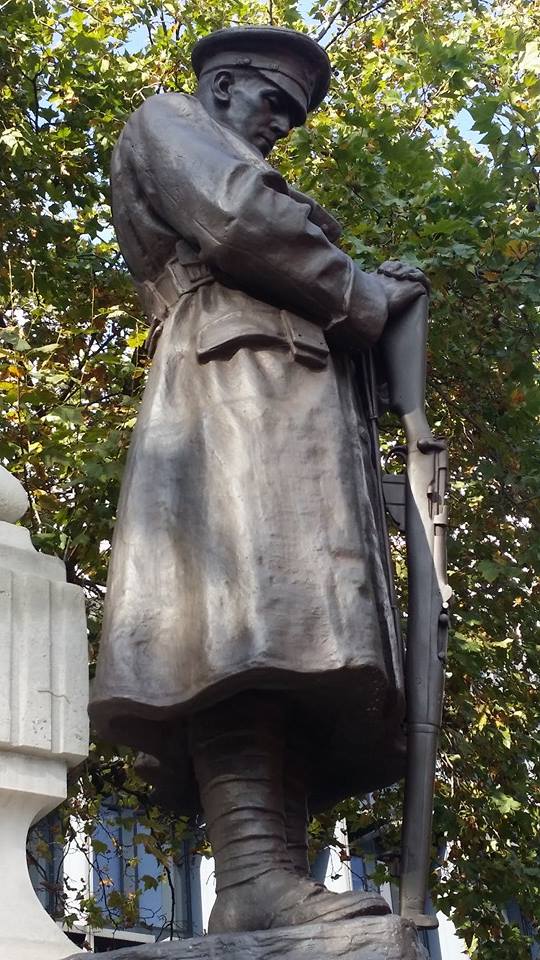
Soldier in Euston Road, London. 3-10-2014. Picture by Tony Martin-Woods

Soldier in Euston Road, London. 3-10-2014. Picture by Tony Martin-Woods

ATS/JB 22nd January 2014
Copyright © 2014. Attila the Stockbroker
Todos los derechos reservados. All rights reserved.

Bob Crow

BOB CROW


There was a man who held his ground.
Fought every inch, and won the day.
His legacy, his members’ lot:
Good work conditions, decent pay.
By Tories and their tabloid dupes
And those who seek more than their share
Just like Millwall, his favourite team,
He wasn’t liked, and didn’t care.


But those who worked in transport knew
Their leader stood right by their side.
No management could lay them low:
They wore their union badge with pride.
He spoke for passengers as well:
Safety, not profit, always first.
Opposing fatal funding cuts –
Paddington, Potters Bar the worst.


Bob Crow. A boxer’s grandson, he:
Led with the left and packed a punch.
The bosses knew he’d take them on:
No smarmy smile, no cosy lunch.
We need more like him, that’s for sure:
Upfront and honest to the last.
He bargained hard and kept his word.
A union leader unsurpassed.


As zero hours contracts grow
And bosses offer Hobson’s choice
Let us not mourn, but organize:
Get off our knees and find our voice!
This man worked hard for workers’ rights:
A fair wage, a safe, steady job.
So join a union and stand firm.
That’s the best way to honour Bob.


Copyright © 2014. Attila the Stockbroker
Todos los derechos reservados. All rights reserved.